Maybe We Live in the Country We Create?
If our daily lives are a mirror of our society, what exactly does ours reflect? And more importantly: do we like what we see? Because if the answer is 'no,' then perhaps the solution isn't to blame the mirror.
The Introduction: The Feeling of Neglect
We walk through the streets of our cities, our villages, even on our beaches. We often see trash outside the bins, broken sidewalks, neglected signs, and buildings crying out for a little care. It's a feeling that runs through us all: one of neglect, carelessness, of a lost opportunity for something better.
The first, almost automatic, reaction is to look for the "culprit." Who is to blame? Where are the authorities? It's a stance that, while it may have its basis, very often leads us into a trap: the trap of inaction. We wait for "someone else" to come and fix things, while we remain spectators in our own lives and our own land.
This disappointment, this aesthetic resignation, is something I feel deeply. Not just for my city, but for every corner of Greece that could be so much more beautiful, so much more cared for.
The Critical Question: The Power of "to Create"
It was then I began to wonder. Instead of endlessly blaming or resigning ourselves to fate, is there another way to see the situation? Maybe, in the end, we don't just live in the country we "deserve" – a heavy, cynical, and resigned phrase – but in the country we create every day?
This small change in the verb, from the passive "deserve" to the active "create," changes everything. Because "to create" means I have power. It means I have a share of the responsibility, and therefore, I have a share in the solution.
This isn't about "shifting blame," but about taking responsibility. It's not about imposition, but about empowerment. It's the recognition that every citizen is an integral part of the whole we call a "country."
The "Little Miss Pumpkin" Philosophy: Beauty as an Act of Culture
At Little Miss Pumpkin, we firmly believe that change begins with the small things. With our own small part, our own microcosm. As Victor Hugo said, "houses resemble their inhabitants." I would dare to extend that: "Countries resemble the citizens who inhabit them."
We cannot build a better society, a better country, if we live surrounded by ugliness, indifference, and carelessness. Beauty, order, and cleanliness are not luxuries. They are necessities. They are indicators of culture, not just of our ancient past, but of our daily culture.
A well-kept street, a clean sidewalk, a balcony in bloom, a well-maintained bench. All these are not just aesthetic choices. They are acts. They are our declaration that "I care." And when you care for your personal space, it's impossible not to start caring for the public space, for your neighborhood, for your city, for your country.
As Plato reminded us, "It is impossible to improve the world if man is not first improved." Let's bring that to today: It is impossible to improve the country if we do not first improve the way we care for ourselves, our home, and the immediate space around us.
The Power of the "Ripple Effect": From "I" to "We"
We cannot change Greece overnight. But we can "repair" it, "beautify" it, piece by piece.
- If I clean the entrance to my apartment building...
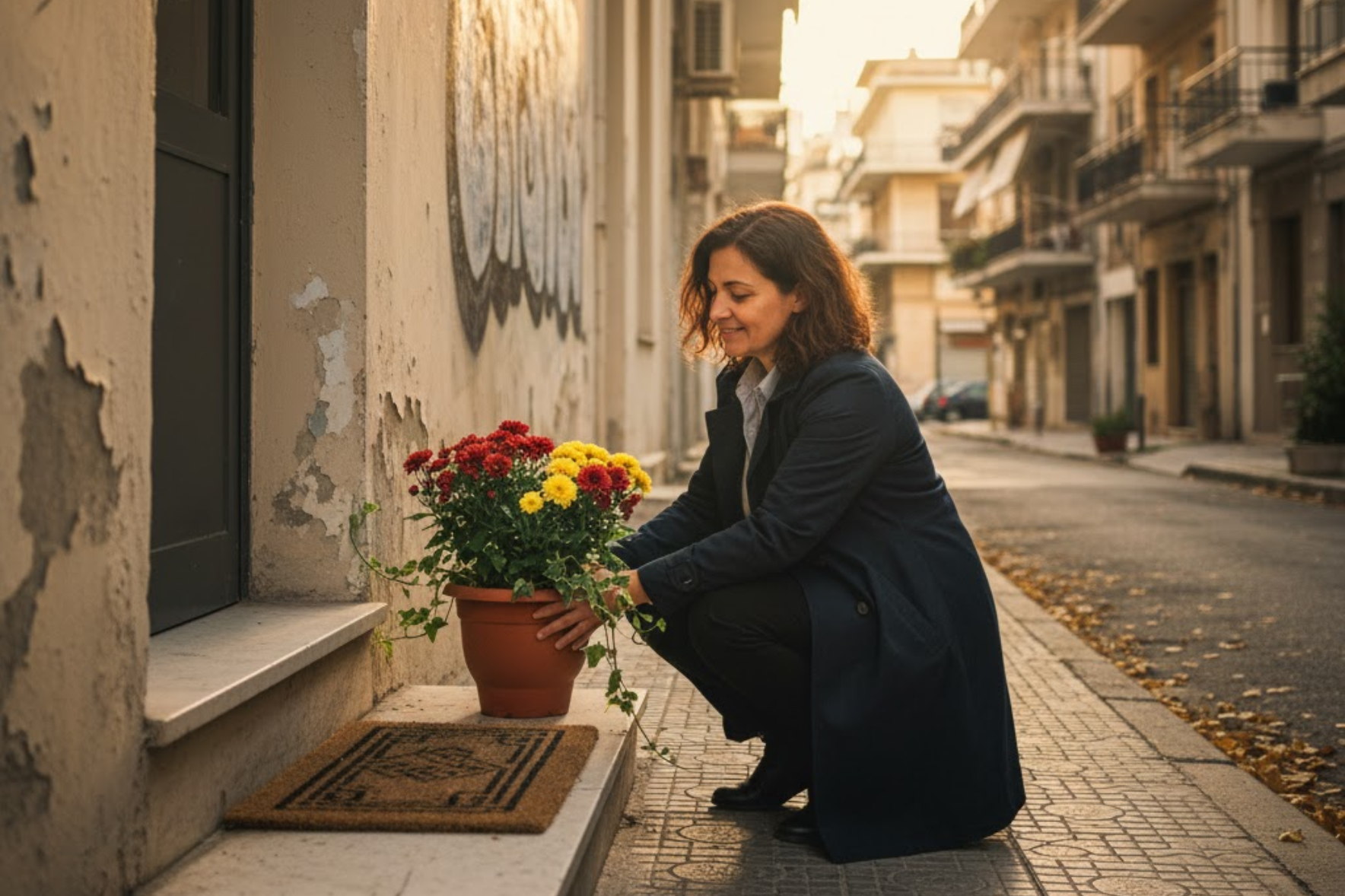
- If you paint your balcony and fill it with flowers...
- If the neighbor across the street tends to the small flowerbed in front of their shop...
...then our street has already become better.
Our neighborhood takes on a new look. And these small acts, like ripples in the water, create a "ripple effect," inspiring others.
This article is not intended to assign blame or cause conflict. It is an open invitation to reclaim our power. To stop waiting for "others" to change everything and to become the protagonists of change ourselves, starting where we have real influence: in our own microcosm.
This is my "political" act. Not partisan, not divisive, but deeply political in the ancient Greek sense of the term: an act that concerns life in the community (polis), respect for our place and our fellow citizens. To do what I can, with what I have, where I am.
Am I overly optimistic or romantic? Maybe so. Many will say that one flowerpot won't change the world. And they might be right.
But isn't it worth trying? Isn't it worth living on a street that is just a little more beautiful? To feel better ourselves, returning to a home and a neighborhood that we have cared for? If the alternative is resignation and complaining, then I choose the romanticism of the act.
The Call to Action: Become a Creator of Beauty Yourself
The country we "create" starts with the home we "create." With the way we care for ourselves, the meal we prepare, the flower we water, the sidewalk we sweep.
The “Better Place Project” is an open invitation for all of us to become little "Little Miss Pumpkins." To take the responsibility for beauty into our own hands, to nurture it with care (meráki), and to let it blossom.
What small thing will you "create" this week to make the world a little more beautiful?